Kristin Scheving explores the pattern recognition of material layers woven into the various cycles that make up the everyday. Scenes of a transitory nature, photographs, video and illustrations are evidence of Kristin’s lifetime of honing her aesthetic for patterns and the threads interwoven in them that are connected to the patterns that engulf us such as the earthly seasons, lunar months, planetary rotations, and epochs of human civilization. She displays a synchronicity between these larger patterns and the patterns of our everyday lives. Working often with video as an artist and curator, her scenes speak of the reception, distillation, and integration of numerous scenes at once or in quick succession. Likewise, Kristin’s patterns do not reveal specificity of place, but the ubiquitous narrative of the global city and the vast amounts of information and data available in the everyday walk on a city street anywhere in the world.
Erin Honeycutt, US/IS writer, poet and book publisher based in Berlin.
UK CURATOR AND ACADEMIC JANE LINDEN REFLECTS ON THE WORK OF KRISTIN SCHEVING
July 2026
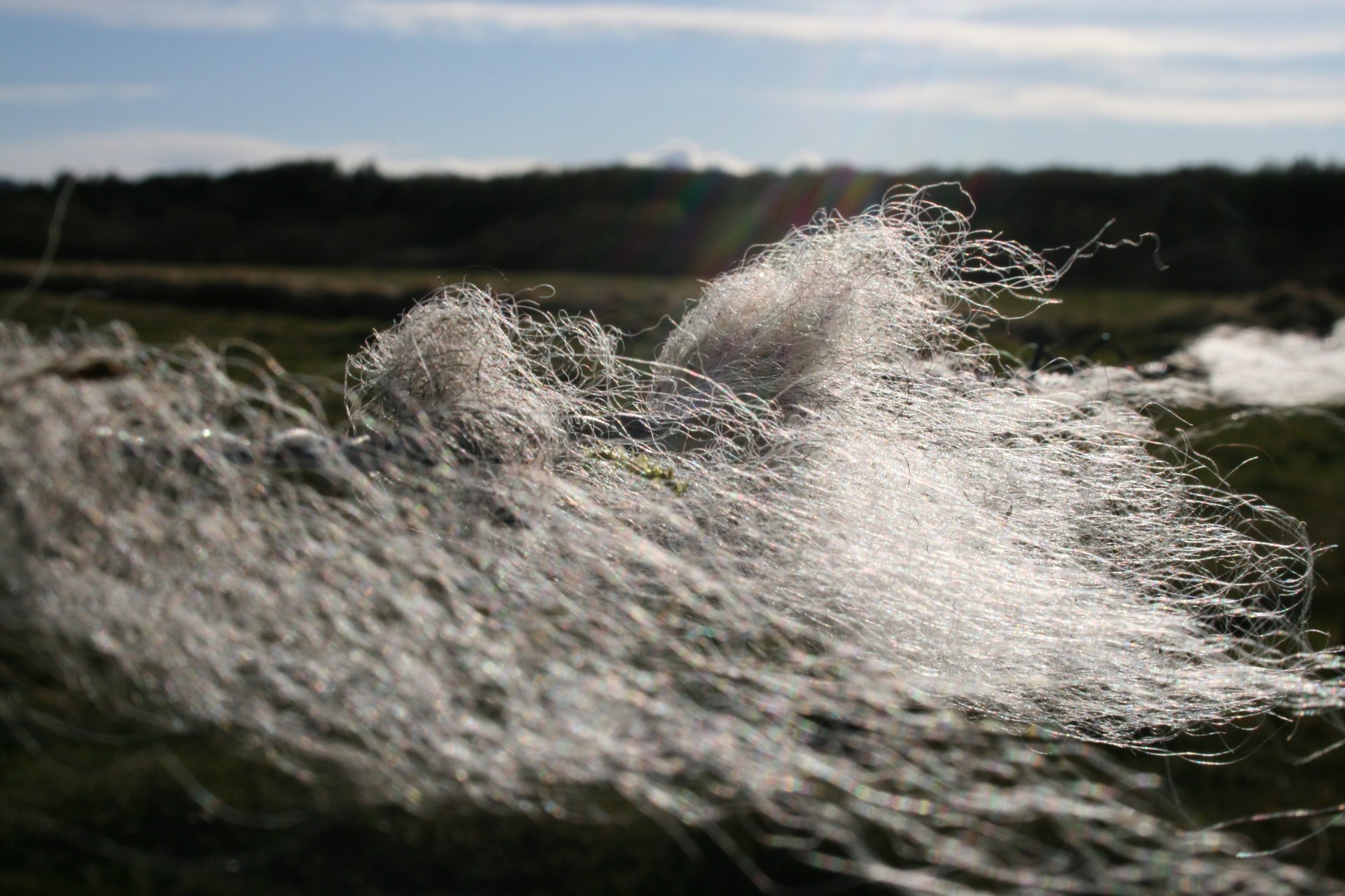
The Woolgatherer
‘Such strange alleys do my thoughts run along when I am woolgathering in the field’ – Anon (1)
THE ARTIST STUDIO
It is difficult not to feel like a trespasser when entering an artist’s studio. More often than not this is a deeply personal and intimate space, with the potential to reveal – not just the intricacies of an artist’s process, the raw materials and tentative experiments but, perhaps more profoundly, insights into the inner sanctum of the artist’s mind. To be invited then, into such a space, and left alone to explore at will, is a privileged opportunity.
Kristin Scheving is hesitant to talk in any great depth about her practice, nor to attempt to define it as having significant artistic value over and above its status as creative output. So, to be asked to interact on an informal level with the wealth and diversity of this material alongside the personal clutter, memorabilia and general everyday ephemera, and to help her consider how these things might reveal the potential to interconnect with one another conceptually, presented a challenge calling for close scrutiny and an open mind.
But isn’t this what is required of us all more generally as consumers of contemporary artworks that are characteristically slippery and indefinable. The value of such offerings, then, is to be found in the extent to which one might feel inclined to give time to engage in dialogue with such complexity. It is not always about the artist’s intent (if there is one) – the worst question you could ask of an artist is “what does it mean?”. We are all at once, detectives, semiologists and psychoanalysts in the face of art, and we take from the work a variety of different readings which an artist may guide us towards, be surprised by or, indeed, be indifferent to.
On opening the door of Kristin Scheving’s studio the first impression (which hits you in the face) is an explosion of colour. Having arrived in this stark, mostly unpopulated, seemingly characterless urban landscape in southern Iceland on a grey day, and walked up the stairs of an equally featureless concrete building, it is easy to be impressed with the stark contrast inside. The walls, floor and surfaces are adorned with a myriad of small colourful images– many pasted onto boards in grid-like form reminiscent of stained-glass windows or garish tapestries.
There is an abundance of neon tape utilised in the fabrication of these pieces – a device which serves to both highlight and obscure elements of this bricolage, so that what looks like an accidental collision of diverse visual ephemera – snapshots of people and buildings, details of maps, bits of text, drawn and painted fragments – would seem to be held together, tentatively, within an organisational and/or conceptual framework, and thus point towards the beginnings of some putative idea at play. We may well wonder whether our attempts to find any sense of narrative or apparent direction in this disparate collection of free-floating signifiers serves any other purpose than to engage with them as compositional experiments – much as Brian Eno, for example, utilises the practice of constructing his ‘mood boards’ which, quite rigidly, determine a set of principles to be applied in the creative process. He says ‘The point about working is not to produce great stuff all the time, but to remain ready for when you can.’. (2)
The wider space of the studio houses several workspaces strewn with evidence of prolific creative production in progress, and a large wall of bookshelves – several rows of which are crammed with A5 ‘sketchbooks’, bursting full of material evidence of personal thought processes. Scheving describes these as her visual diaries, and despite the familiar voyeuristic or narcissistic tendencies to reveal all – having become the norm through social media, that sense of intrusion into an intimate space creeps further to the fore. These personal diaries sit there, dozens and dozens of them, enticingly – waiting to be consumed.
It’s always fascinating see what people have on their bookshelves and what they might boldly reveal about their owners – what they find interesting or inspirational – or what they aspire to; and amongst the usual things we would expect to see in an artist’s library there is a notable, but not surprising, presence here of writing about Surrealism, Feminism, psychoanalysis and of course, autobiographical art.
It is fair to say that such subjects filter in and out of Scheving’s work and may offer some foundational catalyst for her practice. However, those artists whose artworks might fall in to such variable categories – such as Tracey Emin, Louise Bourgois, Freda Kahlo, unlike Kristin Scheving, explicitly declare their work as autobiographical and/or self-confessional, their subjects openly dealing with specific history and trauma in their lives.
Bourgeois says ‘I am a woman without secrets. Anything private should not be a risk, it should be a result, it should be understood, resolved, packaged and disposed of’. (3) She claims, idealistically, that her art offers her some personal healing and therapeutic cleansing of her troubled past – the subjects of which become stimulus for the making of her entire oeuvre. Emin too, is at pains to bring the private into the public domain and she blatantly celebrates the breaking of taboos as part of her own emotional curative. Her candid work has often brought her much criticism as self-absorbed and sensationalist and yet, apart from exploiting her own life experience, she believes that her art holds value as it aspires to open up dialogue with sensitive subjects – thereby dispelling stigma and encouraging empowerment in others.
THE VISUAL DIARIES
So, what might we expect to find amongst the pages of Scheving’s numerous ‘little black books’ that could reveal something of the life experience and psychological neurosis of the person behind the work – albeit on a much more subtle level? Looking through each of these so-called chronicles you would be hard to find any real sense that this relentless hoard of daily recording activity reveals any detailed autobiographical narrative. Rather, what emerges is a characteristic resistance to offering any clear reading of her work.
Here we are presented with a playfully expressive dynamic platform for the interplay of ideas drawn initially from what she encounters through the everyday. Thus, these entries represent shifts in modalities of thought and reflect both her own phenomenological experience of what she is provoked by in the wider external world and what this diverse set of stimuli might evoke or dredge up from the depths of her psyche in terms of past memories good bad and indifferent. Different strata of time and place are brought together along with both a subjective and otherwise dislocated reality. She appears detached from but, at the same time, deeply connected to the world around her.
The pages are filled mostly with line drawn free-style doodles, often continuous and ambling. She appears to be ‘taking a line for a walk’ which calls to mind Freud’s free association technique employed to explore the unconscious mind – and its direct influence on the Surrealist art movement, specifically artists such as Andre Breton who used automatic writing/drawing as a method to produce art. Scheving does concur that her visual diaries contain snatches recovered from her unconscious mind – memories and thought patterns previously hidden and buried. But turning her attention to her diaries before sleep she allows her pencil to trace her thoughts indiscriminately and drift as she reflects on the day – unaware of what might emerge. She says this mark making is ‘done without thought…as if something else is working through me’.
For Modernist artist Paul Klee: ‘A line is a dot that went for a walk. A drawing is simply a line going for a walk’. He suggests that this line must move randomly without particular end in sight, emphasising that ‘Art does not reproduce what we see; rather, it makes us see.’. (4)
So, whilst there is a level of conscious thought underlying this activity there may never be a conclusive vision in sight but rather a continuous journey to be embarked upon – of gathering material as an ongoing process, with one idea, albeit random, leading to another and another. Is there hope that something might be discovered at some point along the line?
Artist and writer Julian Bell reflects that:
‘While engaged in drawing, we are aware that there is something yet to be brought into sight, some impact on the surface that is yet to be delivered. As long as the activity lasts there are lures ahead’. (5)
Interestingly, although there is no apparent overall schema evident, when studying this collection of seemingly chaotic and unrelated material as a body of work, certain self-reflexive patterns of organisation come to the fore – which would appear, to some extent, to point back to the ‘mood boards’ referred to earlier. Almost every image includes some kind of connective symbolism flowing in and out, across and through – there are broken lines, loops, chains, pathways, railway tracks, film-reels, directional arrows and labyrinths, concentric circles, mapping grids and open boundaries and further simple drawn lines flowing continuously from image to script and from script to image.
The world, and all it contains, would seem to be here but where ‘reality’ is flattened into a dynamic pluralistic mesh of free-floating signs; there are no hierarchies of form nor content identified, just endless possible interconnections pointing in and out – transcending the usual dualisms: past and present, dreams and reality, nature and technology, fact and fiction and so on (see page 7). Objective reality becomes just a series of illusions. This work offers a sensation akin to distractedly looking out of the window of a high-speed train, or watching a film-reel of a dreamscape with no apparent linear narrative. Nothing seems connected and yet all becomes part of an inter-linear whole.
As an artist Scheving could be described as a contemporary ‘post-modernist’ in her approach. She blatantly steals, soaks up ‘like a sponge’ anything and everything into the work: snippets of conversation, advertising slogans, Greek mythology, geometric diagrams, faces of strangers, animals, surface patterns and the styles other artists drifting between the pages. Hundertwasser, Klee, Miro, Munch, Kahlo and Carrington and so many others come and go. But these style references are mere snatches – more casually serendipitous pastiche than deliberate reference, in the sense that such images of work she is otherwise interested in, or confronted by, emerge as they enter into the continuous flow of her thought process.
If there is a message deeply buried in the work it is to be found in the medium. Scheving is more interested in the journey – the process. Indeed, we might ask – is there a product here in the usual sense that it would be exhibited or even sold? Yet it is not too difficult to see how the pages of these ‘diaries’ could be organised for viewing – as an installation of course – in and out of book-form, and it is also worth saying that many of these pages warrant consideration as individual pieces. The question then might be more ‘what is lost’? Would such commodification undermine the integrity of such a practice? In the end it might not matter, it just becomes another interesting discursive conundrum.
Scheving also draws inspiration from a wide global lexicon – both mediated and experienced through extensive travel across the cities of Europe, but the lure of the Homeland (where strong memories are made) is equally foregrounded in her work. She is just at home serenely tramping across the wild Icelandic landscape foraging for bilberries and mushrooms and other natural gifts as she is immersing herself in the endless frenzy of the city – gathering as she goes – and is as absorbed by the tracks she makes in snow or sticky mud beneath her feet as she is by following pathways through the labyrinthine cybernetic void. It is these contrasts, this sense of dis-location – of a juxtaposed, and, at the same time, fluid existence that would appear to underline her motivation as an artist.
The Video Work
Scheving is also well known as a prolific video maker and she often combines forms such that the tensions created between the static and the linear seem to be in (albeit sometimes uneasy) dialogue with one another. One can recognise the parallels between her drawn work and film most starkly in the stop start, frame by frame characteristics shared by both and, conversely, the hallmark metaphorical tropes of connectivity she employs to link things together.
Often shown concurrently on a loop, the sequencing of each piece can be unsettling as the nature of the work lurches rapidly from one set of expressions to another. Screams, tears, jarring soundtracks disrupt the balance between such expressions of pain and possible attempts to contain it. Such editorial decisions reinforce Scheving’s concern to identify and further provoke a sense of possible interrelationships between everything and all – despite their apparently random or anachronistic nature. In so doing, she reflects the ideas of contemporary philosopher Donna Haraway, who invites us to think differently about our relationships with our modern messy world and the ways in which we can better inhabit and understand it by opening up a wider more inter-relational perspective: ‘Let’s stop thinking in absolute dichotomies. Not either human or nature, not either technology or emotion, not either right or wrong. We live in a world of relationships, dependencies, and interconnectedness . (6)
Elements of her video work express this sense of ‘connecting’, ‘holding’ or ’gathering in’ even more explicitly than the flux of the visual diaries, though each one of them may have begun its path there as the collection of fragmented ideas begins to cohere. Generally, the videos are eclectic in style and are to be viewed as fragments of a whole perhaps, but others, whilst they share a conceptual relationship, seem more complete in themselves as artworks.
Conscious aesthetic considerations brought about through pace, colour saturation and mise-en-scène will often evoke ethereal, other-worldly qualities in these short films where a sense of narrative would seem to be sparce. Some works have ‘painterly’ qualities requiring a different kind of contemplation. The simplicity of the static camera serves to create an animated photograph still – ‘action’ if any, often slipping out of frame and reappearing seconds later in another place. Time, it would appear, having moved on regardless.
In Snjór (2006), for example, the entire mise-en-scène consists of a small house surrounded by, and immersed in, a thick fall of snow. For some seconds we contemplate this as an image, until a figure slowly breaks into the frame (the artist) in slowed-motion; she is wearing a flimsy white nightdress and big black boots. She carries a large ball of red wool which she unwinds as she staggers forward and throws ahead of herself along the perimeters of the building. Drawn into the interiority of her world as she performs this ritualised and arduous task, we almost feel the shock of the cold as her scantily clad body falls into the drift. We might wonder what significance this particular dwelling has, and why it warrants such earnest attention – its very encircling suggesting it resonates, suspended in time, with uneasy memory – and putatively, perhaps, points towards it as a crime scene.
Moving out of frame she reappears and retraces her steps, but this time she is rewinding her ball of wool as if to erase, undo, obliterate. But her own corporeal impressions in the snow, until such time as it melts, leave a trace of her having been there.
More balls of wool (red and black) appear in Garnaflækja I (2007). Here the scene is of a thicket of small trees where the passage of time is compressed enhancing the subtle shift and changes in light, movement and weather conditions as the seasons roll forward. A woman (the artist again), clearly pregnant with child, laboriously winds her wool around and through the branches: unrolling, looping, binding, crossing-over. The speeded-up action here not only serves to push time forward but also demonstrates transformational integration of the red and black threads as they are duly wind torn, iced-up or rain saturated. She reappears, no longer pregnant. It is summer. She begins the long repetitive process of untangling and retrieving – again perhaps toward a putative ‘healing’ from difficult events that remain suspended in time.
We call to mind that our experience of time and existence in the world is in a constant state of flux, indeed, according to the Greek philosopher Heraclitus, it is impossible to step twice into the same river ‘…for it’s not the same river and he’s not the same man‘. (7) Whilst the sophistry of video allows us to manipulate the passage of time ad infinitum enabling a partial recapture of ephemeral events that otherwise cannot be retrieved, our experiencing of these events, on all counts – mediated or not, will be different each time. What is held in the memory has its own distortions.
Repetitive action, as an effective therapeutic strategy enabling an un-locking of toxic memory, is used by many artists (mostly female) whose work takes personal trauma as a catalyst for creative production
Repetition as a device in Sophie Calle’s work Exquisite Pain (8) apparently documents a period in her life where she attempts to escape from the pain of her heartbreak. For sixty days, recounting and re-narrating her story, in dialogue with strangers’ own stories of grief, she repeats and re-lives the story of her breakup. The process, as it progresses over time, allows her release and diversion from the sting of her lover’s rejection. The material documentation of this exchange, in the form of a book (9), further functions as a means of reclaiming trauma.
In Louise Bourgeoise’s œuvre, where her obsessive preoccupation with her past has fed a career spanning seventy years, pain is embodied in a circular way rather than left behind in a linear trajectory.
Thus, there is no sense of catharsis sought here and the trauma is not obliterated. But such obsessive preoccupation with the same theme offers some agency and empowerment brought about through a symbolic visual vocabulary that runs through her work.
It is, after all, a creative practice – and whilst taking its trajectory from personal experience – like all art – it takes on a life and purpose of its own.
Indeed, Sophie Calle candidly admits that her work is not altogether autobiographical, nor even true, and should not be read as ‘…as a blog nor an intimate diary…. I live the happy moments, the sad ones, I exploit for artistic reasons, to turn them into a piece. Even if the starting point is therapeutic, the real reason is for the piece to end up hanging on a wall or be in the pages of a book’.
And, so it is for Scheving’s practice. But, as we have seen – unlike other autobiographical artists cited here (Calle, Emin, Bourgeoise), there is no life story offered nor any invitation to provoke speculation on the specifics of her past. But there is, undoubtedly an element of a deeper, darker and more intimate thread lurking in the background of her work and her creative process may offer her a kind of healing as noted earlier. The actual laying out of it as an artistic pursuit quietens the anxiety of everyday living and its inevitable reminders of things difficult to process. But memory and creative expression are so closely intertwined here as to be inseparable and indistinguishable.
And so, in turning her gaze both inward and outward she expresses the turmoil of the psyche and the bombardment of the senses acquired through everyday lived and shared experience of contemporary existence. The overall richness of the work, then, is to be found, perhaps, in our own engagement with the process of ‘wool gathering’ with little sense of an end in sight or an answer to the conundrum that is life or that is art. We may gather the fragments together to seek connections between the tangled web of images that may have some personal narrative resonance; we may attempt to decode the proliferation of schematic principles to help guide us through, and we may be provoked to think this way or that way – but to travel down a particular trajectory ultimately gives little sense of catharsis. It is enough, then, to take a step back and appreciate the experience, in all its guises, as it may unfold in front of you.
Beautiful, poetic and disturbing, this is a re-calcitrant, slippery but deeply insightful practice – full of wit and wonder, holding a mirror on to the complexity of layered human existence, our relationships to one another and the world around us, and to the intrinsically linked mysteries of the creative mind.
‘Through thistle and thorn, with no task more exceptional than to rescue a fleeting thought, as a tuft of wool, from the comb of the wind…(10)
… we are the magical artists plucking at the fragments of existence and re-assembling them in some mysterious and wonderful way’.
(1) wool-gathering(n.)
woolgathering, 1550s, “indulging in wandering fancies and purposeless thinking,” traditionally from the literal meaning “gathering fragments of wool torn from sheep by bushes, etc.,” as an activity that necessitates much wandering to little purpose. Woolgatherer is a term in 15c., apparently one who collects wool from sheep-keepers. https://www.etymonline.com/word/wool-gathering
(2) Brian Eno ‘Oblique Strategies’ Brian Eno and Peter Schmidt 1975.
(Designed to help artists, musicians, writers, and creatives break through mental roadblocks and approach their work from fresh, unexpected angles. Created in 1975 by Brian Eno and artist Peter Schmidt, this unique tool encourages lateral thinking by offering unconventional prompts and creative dilemmas. https://enoshop.co.uk/products/oblique-strategies?variant=51221629501780)
(3) Aug 15, 2014 www.studiointernational.com Bourgeois: A Woman Without Secrets
(4) Paul Klee’s Pedagogical Sketchbook, 1925,
(5) Julian Bell, ‘On Drawing’ London Review of Books, 3 April 2025
(6) Quote paraphrased from Andres Delhaas, Philosopher of the Entangled World, Dec 11th 2025 https://nextnature.org/en/magazine/story/2025/future-thinker-donna-haraway
(7) Heraclitus of Ephesus (Ἡράκλειτος, Herakleitos; c. 535 BC – 475 BC) Greek philosopher He viewed the world as constantly in flux, always “becoming” but never “being”. He expressed this in sayings like “Everything flows ”
https://en.wikipedia.org/wiki/Heraclitus
(8) https://www.a4arts.org/works/recYYQC4z0jbQ6Hor-exquisite-pain
(9) Sophie Calle, Exquisite Pain, (translated from French by Charles Penward), Thames & Hudson, 2005
(10) Woolgathering Patti Smith. New Directions, 2021 ISBN 9780811219440 (First published 1992). (‘Throughout “Woolgathering ‘Smith deftly illustrates how memories and artistic expressions are deeply interconnected, each one feeding into the other’.

